
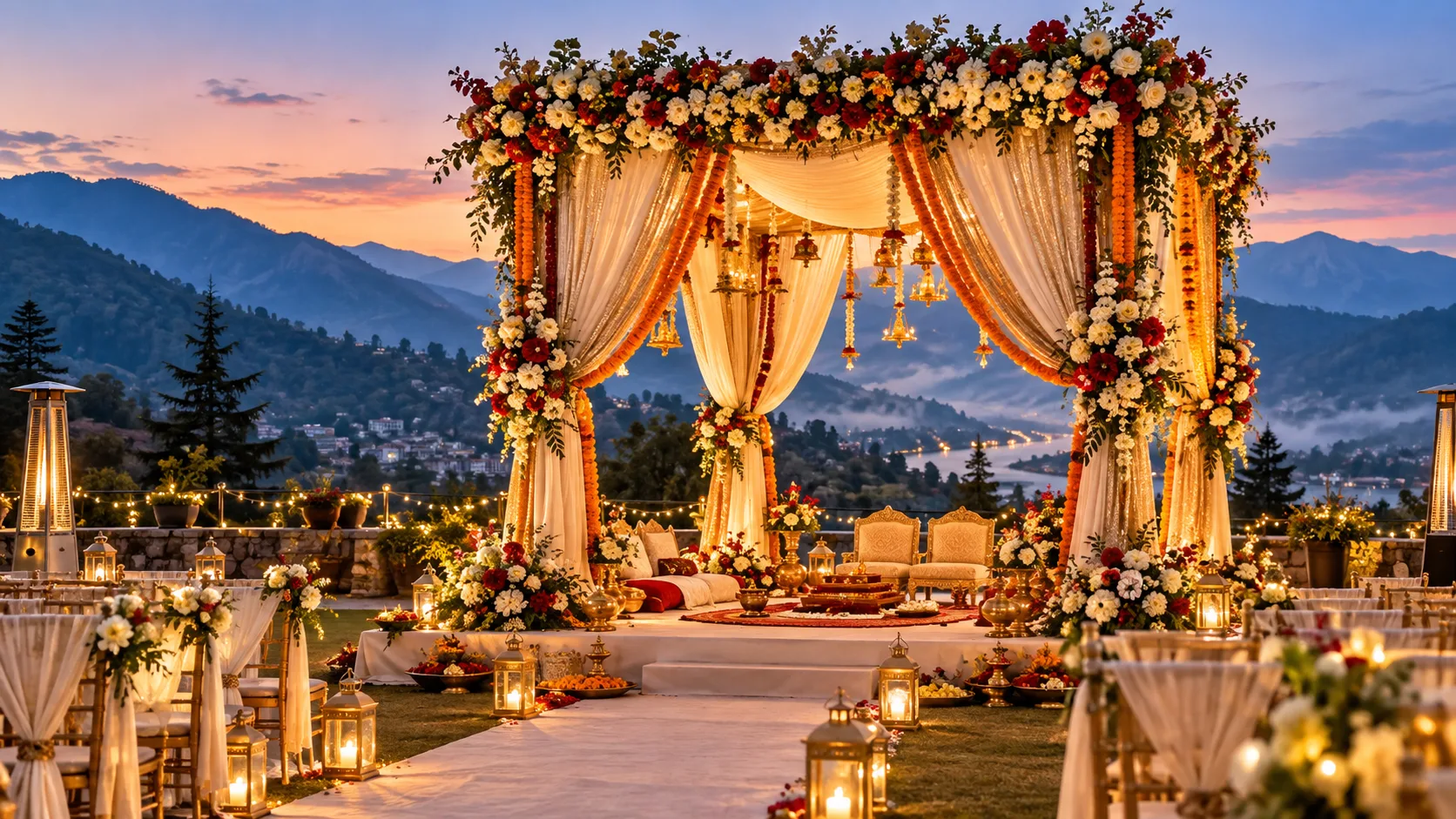
Direct answer: The winter wedding season opens after Dev Uthani Ekadashi on Friday 20 November 2026 and pauses for Kharmas from roughly 16 December to 14 January, resuming mid January and running to mid March. The dates most panchangs agree on are 21, 25 and 26 November, 3, 4, 6 and 12 December, 15, 20, 24, 27 and 31 January, and 3, 11, 21, 26 and 28 February.
The shape of the season
Before the individual dates, the structure. Every panchang agrees on it, and it governs your planning more than any single date does.
Weddings pause through Chaturmas, the four months Vishnu is held to be asleep. That ends on Dev Uthani Ekadashi, Friday 20 November 2026, and muhurats open from then. The season runs about three weeks before stopping for Kharmas, when the Sun transits Dhanu, from around 16 December to Makar Sankranti in mid January. Dates resume from roughly 15 January to mid March, when Kharmas returns.
So the season is not one long run. It is a short burst in late November and early December, a gap of about a month, then a longer stretch from mid January to mid March. Most couples discover the gap after setting their heart on a date inside it.
The dates the panchangs agree on
I compared three published panchangs for this season. They agree on the structure and disagree on a surprising number of individual days. These appear on more than one:
- November 2026: 21, 25, 26
- December 2026: 3, 4, 6, 12
- January 2027: 15, 18, 20, 24, 27, 30, 31
- February 2027: 2, 3, 10, 11, 21, 26, 27, 28
Dates appearing on only one of the three, which need confirming rather than discarding, included 24 November, 2, 5, 10 and 11 December, 19, 23, 25, 26, 28 and 29 January, and 9, 12, 14, 15, 16, 20 and 25 February.
Why the lists disagree
This is not carelessness. A tithi does not begin at midnight; it starts and ends at a particular moment, and whether a calendar day qualifies depends on where that moment falls relative to sunrise, which differs by city. Traditions also differ on whether a tithi touching sunrise is enough, and some panchangs filter nakshatra and yoga more strictly than others.
The practical consequence is simple, and most couples get it the wrong way round. Choose your panchang and your pandit first, then pick the date. Take a date off one website while your family priest follows another tradition and you will be renegotiating a booked venue and a paid advance.
Separate the date from the hour, too. A published muhurat tells you the day is suitable. It does not give you the lagna, the window in which the pheras should happen, which is calculated against both charts and decides whether your ceremony starts at ten in the morning or two at night. Venues price those very differently, so get the lagna before you sign.
The gap nobody plans around
The Kharmas pause from about 16 December to 14 January lands precisely on Christmas and New Year. That matters in Uttarakhand more than it does elsewhere.
Through those weeks every resort in Dehradun, Rishikesh and Mussoorie is full of holiday tourists at peak rates. There are no wedding dates, so no competition from other weddings, but no availability either and nothing negotiable. A December wedding means choosing between the 3rd, 4th, 6th and 12th, and the 12th is the last.
The flip side is the opportunity most couples miss. From 15 January the dates resume while the holiday crowd has gone home. Venue availability is at its best all winter, rates soften, and guests are not competing with tourists for rooms or flights. The second half of January is the most sensible window in the season and the least contested.
What else to check: the temperature at your venue, not in the city
Dehradun averages a maximum of 20°C and a minimum of 6°C in December, 18°C and 5°C in January, and 21°C and 7°C in February. Those are valley figures, taken at about 640 metres.
A venue in Mussoorie sits near 2,000 metres and runs roughly ten degrees colder. A January evening that is pleasant in Dehradun is genuinely cold up there, and an open mandap at that altitude needs heating arranged weeks ahead rather than found on the day. Rishikesh, lower down, runs slightly warmer. Ask for the venue’s altitude, not the nearest city’s temperature.
What else to check: how much light you actually have
This is the detail that quietly rearranges a wedding schedule. Sunset in the Dehradun area falls at about 5:18 pm on 21 November and 5:16 pm on 6 December. By 20 January it is 5:43 pm, and by 21 February it is 6:10 pm.
That is nearly an hour between a late November date and a late February one. On a November or December date, a haldi scheduled for three is finishing in fading light and outdoor portraits need to be done by half past four. On a February date the same schedule has room to breathe. If photography matters, this should influence the date as much as the muhurat list does.
What else to check: rain, which is not evenly spread
December is the driest month of the three by a wide margin, averaging around 19 mm of rain across roughly two days. January averages about 54 mm across three days. February averages about 79 mm across three days.
February is therefore around four times wetter than December. That does not make it a bad month, and the rain usually comes in short spells, but a February outdoor function needs a covered fallback that actually exists. Ask the venue what its wet weather plan is and ask to see the space.
What else to check: getting your guests up the hill
Most Uttarakhand weddings draw their guest list from Delhi NCR, and December and January fog on the plains section is the thing that disrupts arrivals. It is usually heaviest between four and nine in the morning.
The instinct to tell guests to leave very early and beat the traffic is wrong in winter. A nine o’clock departure often arrives sooner than a five o’clock one. Put that in the guest group rather than assuming people know it. Morning flights into Jolly Grant can be delayed by the same fog, so avoid scheduling anything that needs the whole family before early afternoon on arrival day.
What else to check: everyone is booking the same days

The dates that appear on every panchang are the dates every family is trying to book. Venues, caterers, decorators, photographers and pandits all sell out on them first, and prices behave accordingly.
This is where the disputed dates become useful. A date on your family’s panchang but not on the widely circulated lists is just as auspicious for you and far more likely to be available at the venue you want. Ask your pandit whether any of the single source dates work for your charts before settling for a crowded one.
A short order of operations
- Confirm which panchang your family follows.
- Get a shortlist of dates from your pandit, including the less common ones.
- Check each shortlisted date against venue availability before falling in love with one.
- Get the lagna for your preferred date, because it decides the ceremony hour and therefore the venue schedule.
- Only then pay an advance.
Every date in this article is published from panchang calculation and should be confirmed with your own pandit against both charts before anything is booked. If you want the availability picture for a specific date across venues in Dehradun, Rishikesh and Mussoorie, that is the kind of thing we check routinely and it is usually faster than calling venues one at a time. For couples working to a figure, this breakdown sets out what a winter wedding in the valley actually costs.
Frequently asked questions
When does the Hindu wedding season start in winter 2026?
It opens after Dev Uthani Ekadashi, on Friday 20 November 2026, which ends the four month Chaturmas pause. The first muhurat dates follow immediately, on 21, 25 and 26 November.
Why are there no wedding dates between mid December and mid January?
That period is Kharmas, when the Sun transits Dhanu. It runs from around 16 December 2026 to Makar Sankranti in mid January 2027, and no auspicious wedding dates fall inside it. Dates resume from about 15 January.
Why do different websites list different shubh muhurat dates?
A tithi starts and ends at a specific moment rather than at midnight, so whether a calendar day qualifies depends on where that moment sits relative to sunrise, which varies by city. Traditions also differ on how strictly nakshatra and yoga are filtered. Follow the panchang your family follows and confirm with your pandit.
Which winter month is best for a wedding in Uttarakhand?
The second half of January is usually the most practical. The holiday crowd has gone, venue availability is at its best, there are plenty of dates and the light lasts until about 5:43 pm. December is drier but has only four widely agreed dates before Kharmas begins.
How cold does it get at a hill venue in winter?
Dehradun averages 18°C by day and 5°C at night in January. A venue near Mussoorie, at around 2,000 metres, runs roughly ten degrees colder than that. If your mandap is open to the sky, heating needs to be arranged in advance rather than sourced on the day.